In functional analysis, the dual norm is a measure of size for a continuous linear function defined on a normed vector space.
Definition
Let  be a normed vector space with norm
  and let
  denote its continuous dual space. The dual norm of a continuous linear functional
  belonging to is the non-negative real number defined[1] by any of the following equivalent formulas:
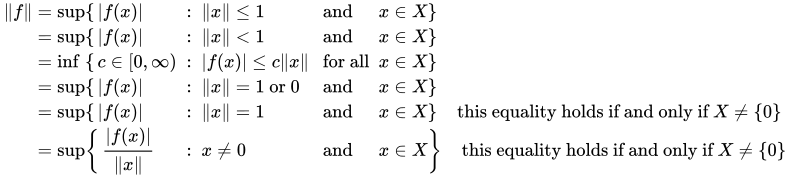
where

and

denote the
supremum and infimum, respectively.
The constant

map is the origin of the vector space
and it always has norm

If

then the only linear functional on
is the constant
map and moreover, the sets in the last two rows will both be empty and consequently, their
supremums will equal

instead of the correct value of

Importantly, a linear function is not, in general, guaranteed to achieve its norm  on the closed unit ball
  meaning that there might not exist any vector
  of norm