File:Regression elliptique distance algebrique donnees gander.svg
From Vigyanwiki
Size of this PNG preview of this SVG file: 452 × 364 pixels. Other resolutions: 298 × 240 pixels | 596 × 480 pixels | 2,543 × 2,048 pixels.
Original file (SVG file, nominally 452 × 364 pixels, file size: 21 KB)
Summary
| Description |
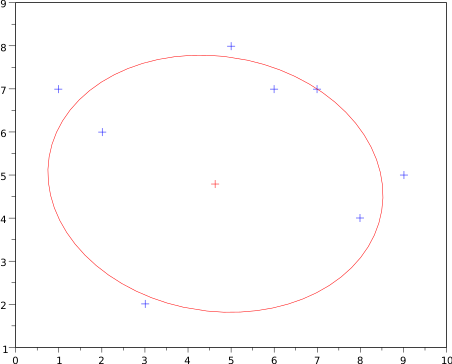
English: Ellipse fitting, using the method of the algebraic distance. Fitzgibbon algorithm (Halíř and Flusser 1998), with test data from Gander et al. 1994.
Français : Régression elliptique, méthode de la distance algébrique. Algorithme de Fitzgibbon, avec les données test de Gander et coll. 1994. |
| Date | |
| Source |
Own work based on:
|
| Author | Cdang |
| SVG genesis |  This trigonometry was created with Inkscape by cdang This trigonometry was created with Inkscape by cdang |


Parameters of the ellipse:
- center: (4.64 ; 4.80);
- major semi-axis: a = 3.91;
- minor semi-axis: b = 2.96;
- tilt angle: φ = -9.21°.
Source code

This media was created with Scilab (free and open source software for numerical computation)
Here is a listing of the source used to create this file.
Here is a listing of the source used to create this file.
// **********
// Initialisation
// **********

clear;

// **********
// Données
// **********

X0 = [1, 2, 5, 7, 9, 6, 3, 8];
Y0 = [7, 6, 8, 7, 5, 7, 2, 4];

// **********
// Fonctions
// **********

function [a] = regression_elliptique(X, Y) // Fitzgibbon
    // méthode de la distance algébrique
    // X, Y : points expérimentaux, matrices colonnes réelles
    // a : coefficients de la formule quadratique (matrice colonne réelle)
    D = [X.*X, X.*Y, Y.*Y, X, Y, ones(X)]; // matrice de conception (design m.)
    S = D'*D; // matrice de dispersion (scatter m.)
    C = zeros(6,6);
    C(1,3) = 2; C(2,2) = -1; C(3,1) = 2; // matrice de contrainte
    [vecpropres, valpropres] = spec(inv(S)*C); // détermination du
    // système propre
    if imag(vecpropres) <> 0 then
        error('Les vecteurs propres contiennent des valeurs complexes')
    end
    if imag(valpropres) <> 0 then
        error('Les valeurs propres contiennent des valeurs complexes')
    end
    vecpropres = real(vecpropres); // complexes -> réels
    valpropres = real(valpropres);
    [PosLigne, PosColonne] = find((valpropres > 0 & ~isinf(valpropres)));
    // recherche les indices des valeurs propres positives
    a = vecpropres(:, PosLigne); // vecteur propre correspondant
endfunction

function [phi]=trouve_rotation(A)
    // A : coefficients de la formule quadratique (matrice colonne réelle)
    // phi : angle que fait un axe de l'ellipse avec x (radians)
    delta = 1 - 1/(1 + (A(3) - A(1))^2/A(2)^2);
    absphi = acos(sqrt((1 + sqrt(delta))/2));
    signephi = sign(A(2)*(cos(absphi)^2 - sin(absphi)^2)/(A(1) - A(3)));
    phi = signephi*absphi;
endfunction

function [x,y]=trouve_centre(A)
    // A : coefficients de la formule quadratique (matrice colonne réelle)
    // x, y : coordonées du centre de l'ellipse (réels)
    delta = A(2)^2 - 4*A(1)*A(3);
    x = (2*A(3)*A(4) - A(2)*A(5))/delta;
    y = (2*A(1)*A(5) - A(2)*A(4))/delta;
endfunction

function [rx, ry]=trouve_rayons(a, phi, xc, yc)
    // a : coefficients de la formule quadratique (matrice colonne réelle)
    // phi : angle que fait un axe de l'ellipse avec x
    // xc, yc : coordonnées du centre de l'ellipse
    // rx, ry : rayons (grand et petit demi-grands axes) de l'ellipse
    A = [a(1), a(2)/2 ; a(2)/2, a(3)];
    Q = rotate([1,0;0,1], phi); // matrice de rotation
    t = [xc;yc]; // matrice de translation
    Abar = Q'*A*Q;
    b = [a(4);a(5)];
    bbar = (2*t'*A + b')*Q;
    c = a(6);
    cbar = t'*A*t + b'*t + c;
    rx = sqrt(-cbar/Abar(1,1));
    ry = sqrt(-cbar/Abar(2,2));
endfunction

function [] = trace_ellipse(xc, yc, a, b, phi)
    // trace l'ellipse de centre (xc, yc)
    // de rayons a et b et tournée de phi
    pas = 0.1;
    t = 0:pas:%pi/2;
    X = a*cos(t);
    Y = b*sin(t);
    n = 4*size(X,'*');
    XY1 = [X, -flipdim(X,2), -X, flipdim(X,2);...
        Y, flipdim(Y,2), -Y, -flipdim(Y,2)];
    XY = rotate(XY1, phi) + [xc*ones(1,n);yc*ones(1,n)];
    xpoly(XY(1,:), XY(2,:));
endfunction

// **********
// Programme principal
// **********

// lecture des données

Xdef = X0';
Ydef = Y0';

// Régression
aopt = regression_elliptique(Xdef, Ydef);

// affichage des paramètres
disp(aopt)

phi = trouve_rotation(aopt);
phideg = phi*180/%pi;
[xc, yc] = trouve_centre(aopt);
[a, b] = trouve_rayons(aopt, phi, xc, yc);
disp('phi = '+string(phi)+' rad = '+string(phideg)+'°.');
disp('C('+string(xc)+' ; '+string(yc)+').');
disp('a = '+string(a)+' ; b = '+string(b)+'.');

// tracé
clf;

plot(Xdef, Ydef, 'b+')
isoview(0, 10, 1, 9);
plot(xc, yc, 'r+')
trace_ellipse(xc, yc, a, b, phi);
ell = gce();
ell.foreground = 5;
It is also possible to use the Halíř algorithm (split matrices). The algorithm is more stable, and the result is the same.
function [a] = regression_elliptique(X, Y) // Halir
    // méthode de la distance algébrique
    // X, Y : points expérimentaux, matrices colonnes réelles
    // a : coefficients de la formule quadratique (matrice colonne réelle)
    D1 = [X.*X, X.*Y, Y.*Y];
    D2 = [X, Y, ones(X)];
    // matrices de conception (design m.)
    S1 = D1'*D1;
    S2 = D1'*D2;
    S3 = D2'*D2;
    // matrices de dispersion (scatter m.)
    T = -inv(S3)*S2';
    N = S1+ S2*T;
    M = [0.5*N(3, :) ; -N(2,:) ; 0.5*N(1, :)]; // mult par inv(C1) à gauche
    // matrice de dispersion réduite
    [vecpropres, valpropres] = spec(M);
    vep = real(vecpropres);
    // détermination du système propre
    condition = 4*vep(1, :).*vep(3, :) - vep(2, :).^2;
    // évaluation de a'Ca
    a1 = vep(:, find(condition > 0));
    a = [a1 ; T*a1]; // vecteur propre correspondant à la solution
endfunction
Licensing
I, the copyright holder of this work, hereby publish it under the following licences:

|
Permission is granted to copy, distribute and/or modify this document under the terms of the GNU Free Documentation Licence, Version 1.2 or any later version published by the Free Software Foundation; with no Invariant Sections, no Front-Cover Texts, and no Back-Cover Texts. A copy of the licence is included in the section entitled GNU Free Documentation Licence. |


This file is licensed under the Creative Commons Attribution-Share Alike 3.0 Unported, 2.5 Generic, 2.0 Generic and 1.0 Generic licence.
- You are free:
- to share – to copy, distribute and transmit the work
- to remix – to adapt the work
- Under the following conditions:
- attribution – You must give appropriate credit, provide a link to the licence, and indicate if changes were made. You may do so in any reasonable manner, but not in any way that suggests the licensor endorses you or your use.
- share alike – If you remix, transform, or build upon the material, you must distribute your contributions under the same or compatible licence as the original.
You may select the licence of your choice.
File history
Click on a date/time to view the file as it appeared at that time.
| Date/Time | Thumbnail | Dimensions | User | Comment | |
|---|---|---|---|---|---|
| current | 15:32, 21 December 2012 | No thumbnail | 452 × 364 (21 KB) | wikimediacommons>Cdang | {{Information |Description ={{en|1=sign error in algorithm}} |Source ={{own}} |Author =Cdang |Date = |Permission = |other_versions = }} |
File usage
The following page uses this file:


