List of trigonometric identities
Latest revision as of 21:30, 15 July 2023
In trigonometry, trigonometric identities are equalities that involve trigonometric functions and are true for every value of the occurring variables for which both sides of the equality are defined. Geometrically, these are identities involving certain functions of one or more angles. They are distinct from triangle identities, which are identities potentially involving angles but also involving side lengths or other lengths of a triangle.
These identities are useful whenever expressions involving trigonometric functions need to be simplified. An important application is the integration of non-trigonometric functions: a common technique involves first using the substitution rule with a trigonometric function, and then simplifying the resulting integral with a trigonometric identity.
Pythagorean identities
File:Trigonometric functions and their reciprocals on the unit circle.svg Trigonometric functions and their reciprocals on the unit circle. All of the right-angled triangles are similar, i.e. the ratios between their corresponding sides are the same. For sin, cos and tan the unit-length radius forms the hypotenuse of the triangle that defines them. The reciprocal identities arise as ratios of sides in the triangles where this unit line is no longer the hypotenuse. The triangle shaded blue illustrates the identity

, and the red triangle shows that

.
The basic relationship between the sine and cosine is given by the Pythagorean identity:

where  means
means  and
and  means
means 
This can be viewed as a version of the Pythagorean theorem, and follows from the equation  for the unit circle. This equation can be solved for either the sine or the cosine:
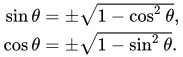
where the sign depends on the quadrant of 
Dividing this identity by , , or both yields the following identities:
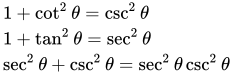
Using these identities, it is possible to express any trigonometric function in terms of any other (up to a plus or minus sign):
Each trigonometric function in terms of each of the other five.[1]
| in terms of
|

|

|

|

|

|

|

|
|

|
|

